
Checking Ventura County Criminal History
Ventura County has no single public rap-sheet search. Start with the Ventura Superior Court criminal and traffic search when the goal is a filed case. It accepts a first and last name, case number, citation number, or bail bond number. A separate docket search shows the lasting sequence of hearings and filings. Current custody starts with the Ventura County Sheriff inmate search, while an incident report stays with the agency that wrote it.
Prepare the full name and spelling variants before searching. Date of birth and driver-license searches are not available in the court interface after the Hamrick privacy ruling, so a matching name must be checked against case details, filing dates, and other public facts. For a certified result or a file that is not online, contact Superior Court Records.
- Choose court, custody, police report, or personal DOJ review based on the record needed.
- Search the official interface with the strongest available key, such as a case or booking number.
- Compare identifiers and dates before treating a result as the correct person.
- Open the docket, booking detail, or agency report channel for the underlying record.
- Ask the record-holding office for copies or certification when an online screen is not enough.
Three Ventura County Record Counters
Most Ventura County criminal record work leads to one of three custodians. Superior Court Records holds filed cases and dispositions. Sheriff Records & Licensing holds sheriff reports, booking products, and calls for service. California DOJ holds the state criminal-history repository and gives people a fingerprint-based way to review their own record. A police department remains the first stop when its officers created the incident report.
Superior Court Records
Hall of Justice, Room 218, 800 South Victoria Avenue, Ventura. File viewing and copy requests are handled here.
Sheriff Records & Licensing
800 South Victoria Avenue, Ventura. Phone 805-654-2336 for sheriff-held reports and booking records.
California DOJ
The Record Review process uses Live Scan fingerprints for a person to inspect a California criminal history.
California Official Background Checks
The California Department of Justice Record Review is the official path for reviewing your own California criminal history. California does not provide a public DOJ name search. A person submits Live Scan fingerprints, and the fingerprint response can reveal repository entries that a county court name search does not assemble into one report.
The standard DOJ processing fee is $25, separate from any Live Scan rolling fee. DOJ also describes a fee-waiver process for eligible applicants. A record review is not the same as a Ventura County case lookup: the repository depends on fingerprints and disposition reporting, while the court file is the source for the actual pleadings and docket.
Ventura Case Search Has No Birth-Date Field
The court removed date-of-birth and driver-license searching to comply with the California Court of Appeal decision in Hamrick. That makes careful matching vital when names are common. The criminal and traffic case search supports first and last name, case number, citation number, and bail bond number, with reCAPTCHA before results.
| Search key | Best use | Limit |
|---|---|---|
| First and last name | Initial discovery | No birth-date filter |
| Case number | Direct file match | Must already be known |
| Citation number | Traffic or citation matters | Exact entry helps |
| Bail bond number | Bond-linked tracking | Applies only when issued |
The court's case inquiry instructions explain the available online routes. Older felony coverage may be partial before 1995, and online results are not a substitute for the file in Room 218.
The Superior Court illustrates how its public case inquiry works on the linked official page.
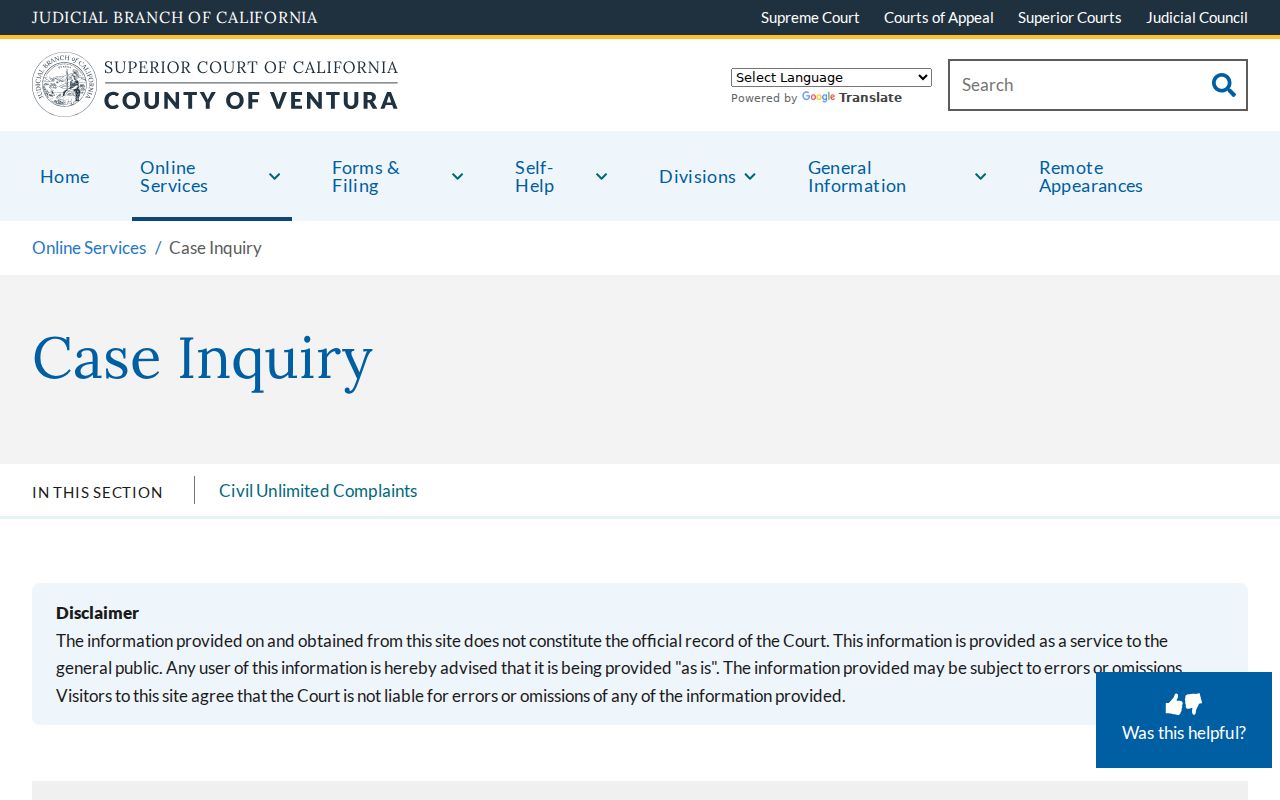
The interface directs a reader toward the correct court search while keeping restricted identifiers out of public queries.
Criminal Record Types
A Ventura County arrest can produce several related records without making them identical. The arresting agency writes an incident or arrest report. The Sheriff creates a booking record if the person enters county custody. The District Attorney may file charges, which create a Superior Court case. Fingerprints and later dispositions may flow to California DOJ. Each custodian answers a different question.
- Arrest and booking records: agency reports explain the event, while Sheriff booking data tracks admission and custody.
- Criminal court files: charges, hearings, pleas, rulings, disposition, and sentence live with Superior Court.
- DOJ history: fingerprint-linked entries form the state repository record available through subject-only review.
- Warrant information: court dockets, agency contact, and records requests are the available fallbacks because no countywide warrant portal was found.
- Supervision and registry data: county probation, CDCR, and California Megan's Law each maintain a distinct official layer.
Ventura County Docket and Case Status
A case status is a snapshot, while a docket is the cumulative trail. The official Ventura docket search can help trace hearings and entries after a case number is known. A dismissal, plea, or sentencing event should be read in sequence instead of inferred from one charge line.
The court's docket interface is the official source for that public event history.
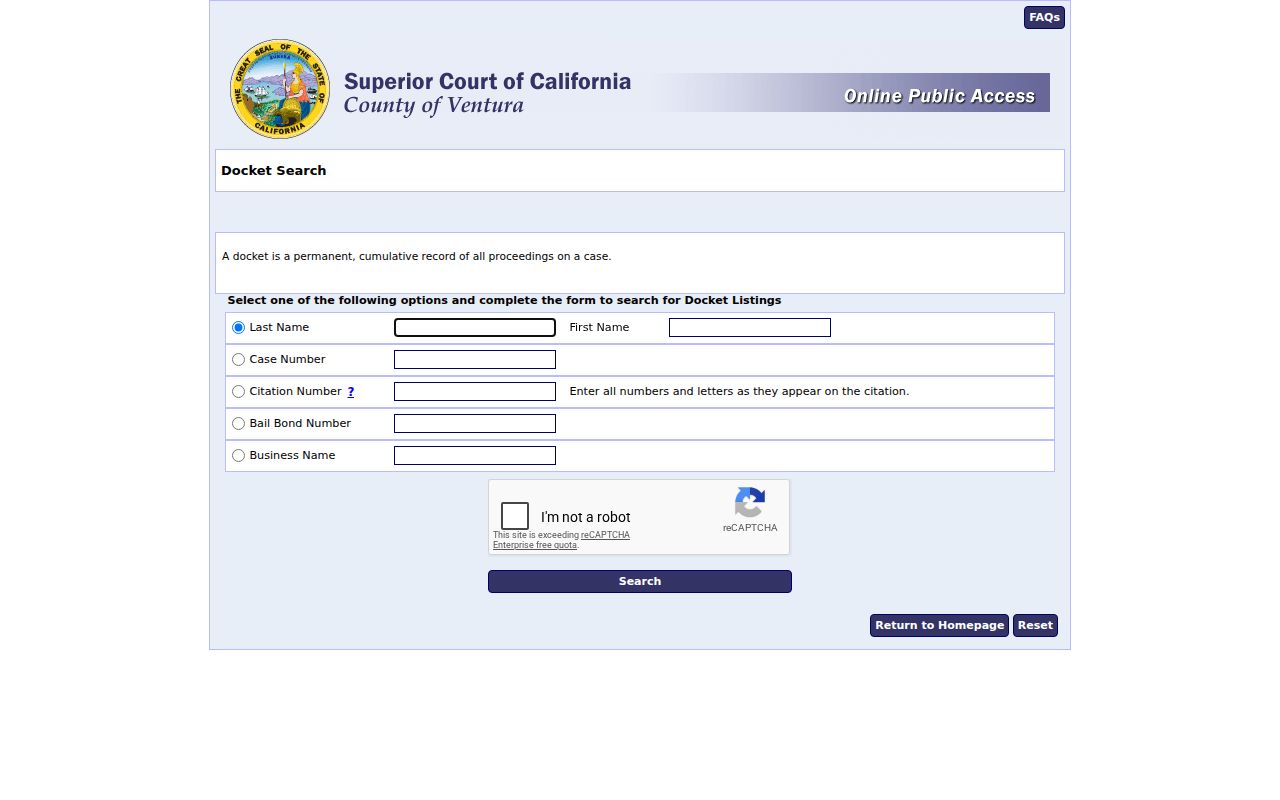
When the online docket is unclear, the case file held by Superior Court Records supplies the documents behind those short entries.
Inside a Ventura County Criminal Record
Content changes with the record source. A court file focuses on the case and legal result. A booking record focuses on custody. A DOJ response joins fingerprint-linked history. Names alone can misidentify a person, so read identifiers, agency, dates, charges, and outcomes together.
| Name & Identifiers | Names, aliases, and public identifiers that help separate similar records. |
|---|---|
| Arrest / Booking Data | Arrest date, agency, booking number, custody location, and release information when public. |
| Charges & Statutes | Filed or booked allegations with California code references and felony or misdemeanor classification. |
| Disposition | Dismissal, acquittal, plea, conviction, or another final court result. |
| Sentence | Custody, fines, probation, or other terms imposed by the court. |
| Custody / Supervision Status | Current jail, prison, probation, or parole information held by the responsible agency. |
Sheriff Records and Licensing Fees
Ventura County Sheriff Records & Licensing accepts requests at the Government Center and through the county's public-records process. The research documents common products and fees, but access still depends on California disclosure law and the requester's relationship to the record.
| Record product | Documented fee | Important limit |
|---|---|---|
| Crime or incident report copy | $20 | Release rules may limit content |
| Booking sheet | $20 | Request the correct booking |
| Booking photograph | $20 | Available only to authorized persons |
| Calls for service summary | $20 | Summary is not the full report |
Requests may be emailed to vcso.publicrecordsrequests@ventura.org. The county's NextRequest portal also serves as a California Public Records Act channel, and the ordinary statutory response period is ten days to determine whether responsive records can be disclosed, not a promise that production is complete in ten days.
Ventura County Jail or CDCR
Use the Sheriff inmate search for a person believed to be in Ventura County jail. It supports a name or booking number and may display an email icon beside a listed person. The red-envelope workflow requires the sender's name and email, a message, and confirmation that enough identifying information appears before submission.
Use the CDCR Incarcerated Records and Information Search for state-prison custody. A person sentenced under California realignment may remain in county jail, so the sentence and custody agency determine which locator is useful. Probation is county-run, while parole supervision is handled through CDCR's Division of Adult Parole Operations.
Public Access Laws in California
Public access does not mean every criminal-history detail is open. Ventura County agencies apply the California Public Records Act to agency records, while courts follow judicial access rules. California also limits dissemination of DOJ criminal-history information, protects juvenile and sealed material, and restricts the information placed on the public registry.
Key Statutes:
Government Code § 7920.000 et seq. - The California Public Records Act governs access to records held by county and city agencies, subject to exemptions.
Penal Code § 11105 - California limits who may receive state summary criminal-history information.
Penal Code § 1203.4 - Eligible people may seek dismissal relief after completing qualifying probation terms, but the record is not erased.
Penal Code § 290.46 - Megan's Law controls public registry disclosure and penalizes misuse.
Ventura County Arrest Reports Stop at 90 Days
Ventura Police operates the strongest official local recent-arrest search found in the research. Its advanced interface covers only the last 90 days. It excludes detention-only arrests under Penal Code section 849(b)(1), and it does not publish minors' names or birth dates. Searches can use date range, name, statute, description, arrest location, or arrest report number.
That tool covers Ventura Police arrests, not every agency in Ventura County. Oxnard Police and Simi Valley Police direct records questions to their own units. Sheriff-policed areas use Sheriff Records & Licensing. Current county custody still belongs in the Ventura County arrest lookup, followed by the court search if charges were filed.
The official criminal and traffic interface remains a separate access point after an arrest reaches court.
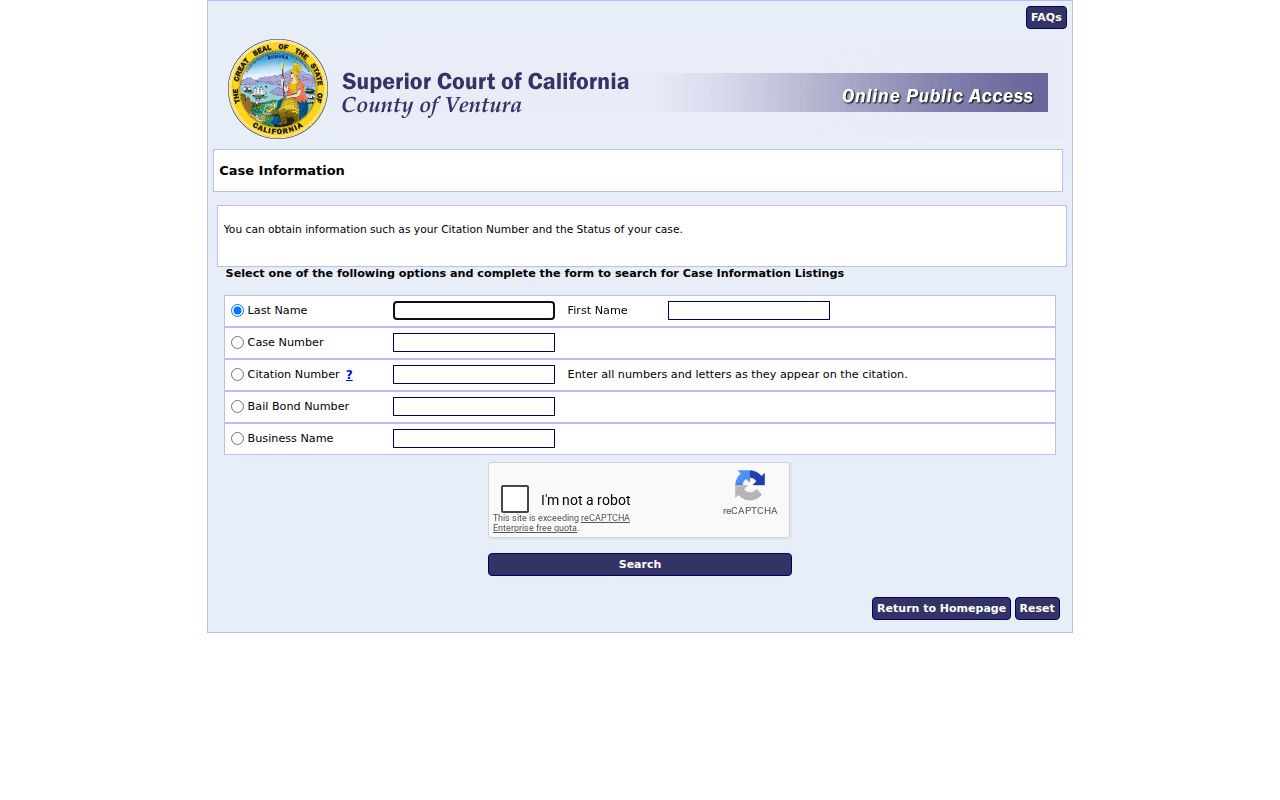
This separation is why one name search cannot stand in for agency reports, booking data, and a final case outcome.
Sealed, Expunged, and Restricted Records
California uses several forms of relief and restriction. Juvenile files are generally confidential. Sealed cases and records may disappear from ordinary public results even though an authorized agency can still retain access. Penal Code section 1203.4 dismissal relief is often called expungement, but it does not erase the historical court file or remove every legal consequence.
A missing online result can also reflect older data, a name-search limit, or a protected case rather than proof that no record exists. For your own state history, DOJ record review provides a correction process. For a Ventura County court file, ask Superior Court Records what is public and whether a certified copy or petition is required.
The Superior Court records department explains the official file and copy channel.
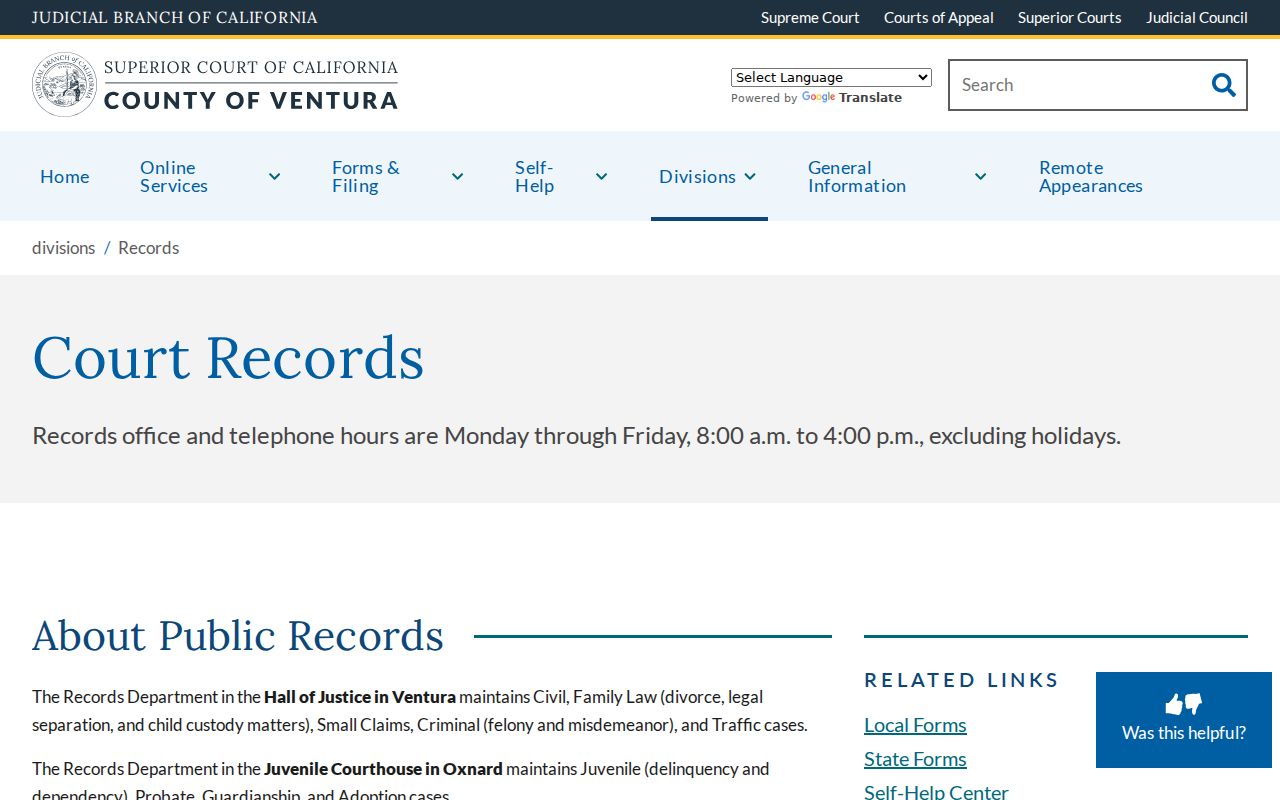
Relief questions depend on the exact case, so the court file is the sound starting point before legal advice is sought.
Megan's Law Is Current but Limited
The California Department of Justice updates the Megan's Law public site daily from registration information supplied by local agencies. Yet some registered people are not subject to public disclosure, and only qualifying registrable sex offenses appear. A registry profile is not a full Ventura County criminal history.
The official California Megan's Law Website supports public safety and community awareness. Address display can range from a home address to ZIP Code, city, and county, or no public entry, depending on California law. The dedicated Ventura County sex offender search explains lawful searching, profile fields, correction steps, and misuse penalties.
California DOJ's registry gateway shows the statewide public entry point.
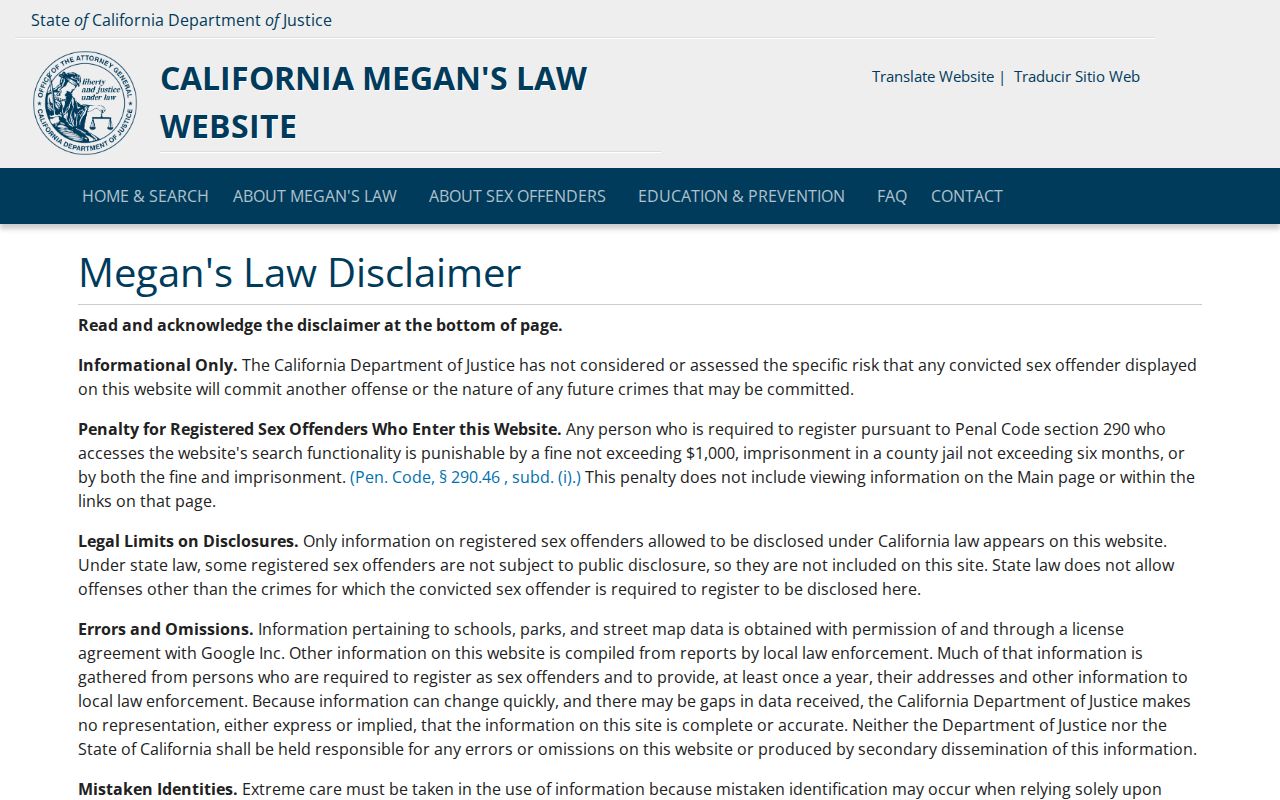
Use the registry for its narrow safety purpose and confirm details through the agency that maintains the registration.
Ventura County Criminal Records by City
The county's three largest cities do not share one police-record path. Oxnard and Simi Valley have city police departments. Thousand Oaks contracts with the Ventura County Sheriff for law enforcement, so its city-government archive and its police records have different custodians. Modern criminal cases from all three cities belong to Ventura Superior Court because California's municipal courts were unified into Superior Court.
Oxnard Criminal Records
Largest city · Oxnard Police Records handles city police reports and offender registration compliance.
Thousand Oaks Criminal Records
Sheriff contract city · VCSO holds law-enforcement records while City Hall keeps municipal documents.
Simi Valley Criminal Records
East County hub · City police and the East County Courthouse both sit on Alamo Street.
Ventura County Court Access Is Changing
Ventura Superior Court launched a redesigned main website in December 2025, while criminal and traffic lookup remains on the older Court Services interface. That split can make an official tool look detached from the current court site. Use links from the court's own online-services pages and check current notices before visiting a department.
The Ventura Superior Court homepage is the reliable gateway for current locations and notices.
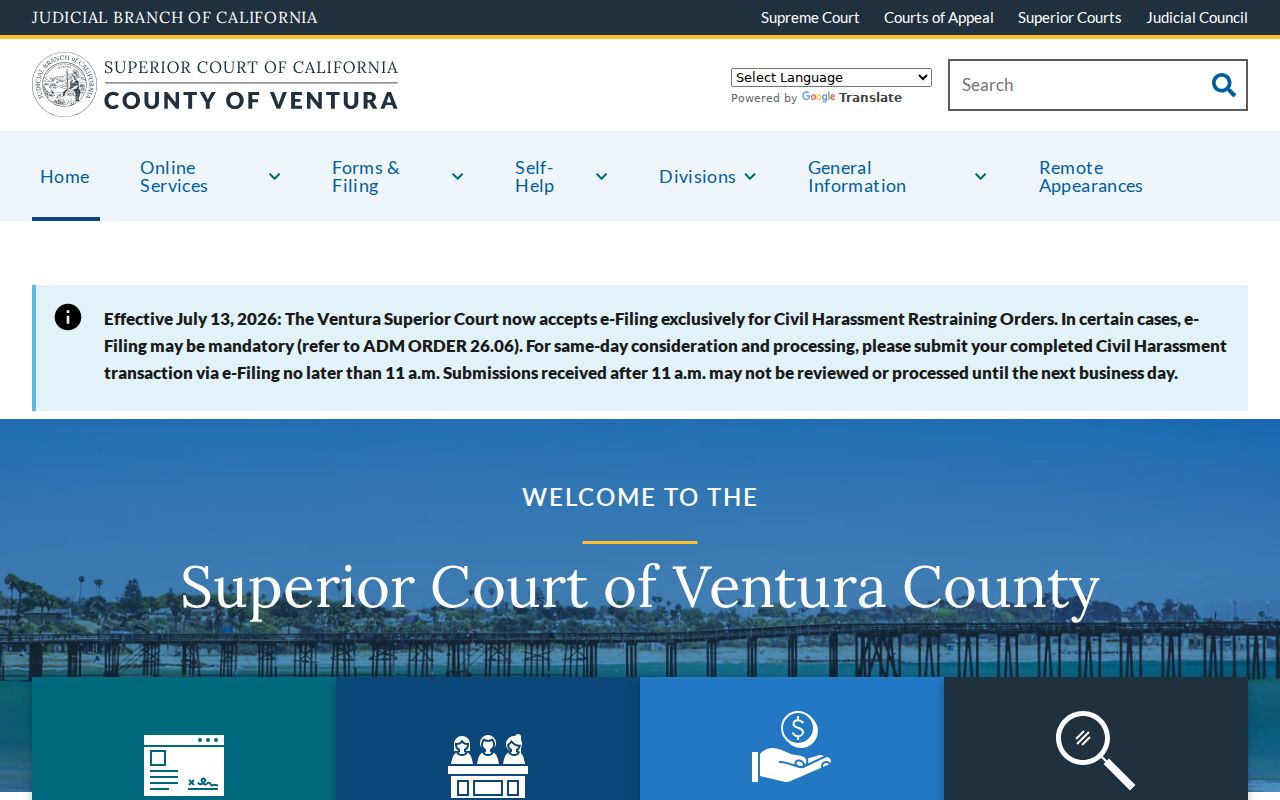
The court's technology may change, but the record custodian remains Superior Court and the criminal file still requires the criminal-search or records route.